
Electronics & Communication Engineering (ECE)
About the Department

The Department of Electronics & Communication Engineering was started in the academic year 2011–2012. The Department of Electronics & Communication Engineering is approved by the All India Council for Technical Education (AICTE) and is permanently affiliated to Anna University, Chennai, Tamil Nadu. The department is committed to providing quality education and technical knowledge in the fields of Electronics, Communication Systems, Embedded Technology, and emerging electronic innovations.
The department provides a strong academic environment supported by experienced faculty members, modern teaching methodologies, and practical-oriented learning. Students are encouraged to enhance their technical skills through workshops, seminars, industrial training, projects, and research activities to meet the challenges of the rapidly developing technological world. The curriculum is designed to strengthen both theoretical knowledge and practical skills required for industry and higher education.

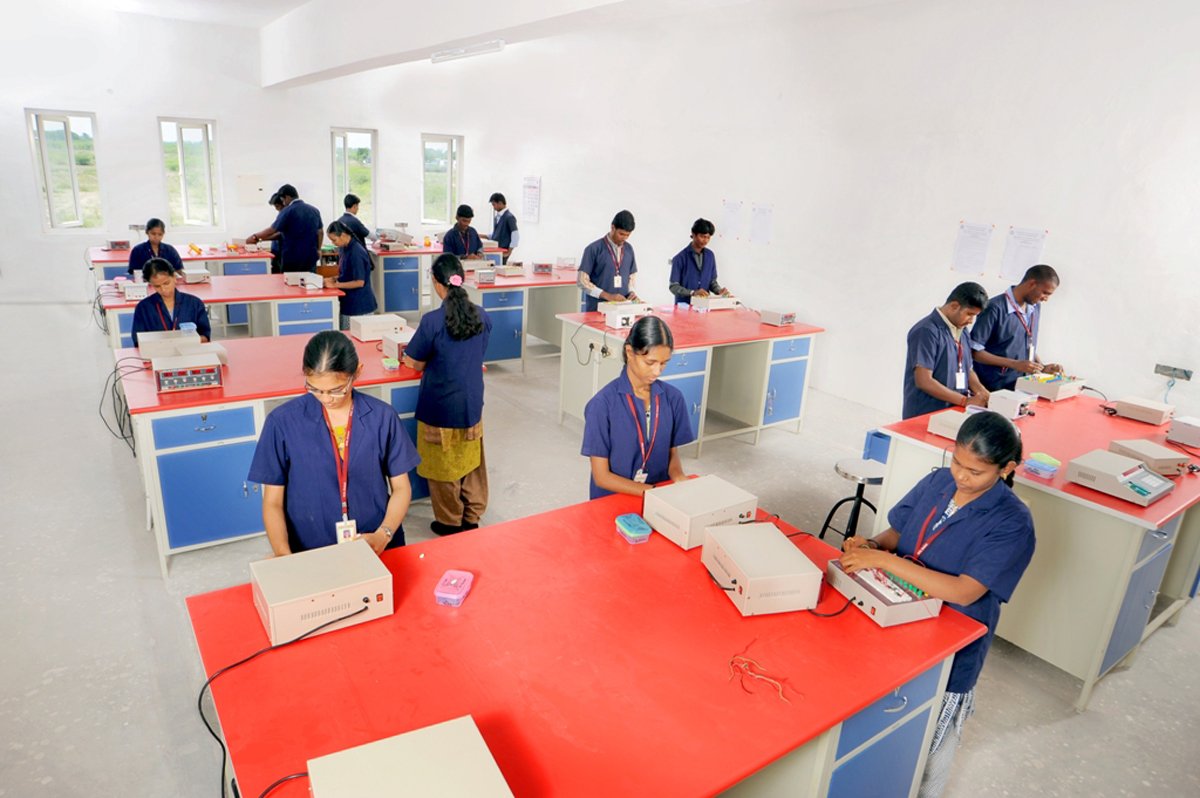
The department is equipped with modern laboratories and advanced infrastructure to support effective learning and research activities. All laboratories are supported with Wi-Fi, LAN connectivity, modern electronic equipment, and updated software tools to provide hands-on experience for students. With excellent academic support and industry-oriented training, the department aims to develop competent engineers capable of achieving success in national and international organizations.

DEPARTMENT VISION

To become a centre of excellence in computer science Engineering by empowering with technical knowledge, innovative thinking to fulfil industry requirements and address societal needs

DEPARTMENT MISSION

PROGRAM EDUCATIONAL OBJECTIVES (PEOs)

PEO -1

Graduates will excel in their professional careers by acquiring strong knowledge in computing fundamentals and principles.

PEO -2

Graduates will excel in their career in industry, higher studies or entrepreneurship through demonstrating ethical responsibility, continuous learning and leadership .

PEO -3

Graduates will apply their domain knowledge and solutions to address societal and environmental challenges by contributing responsibly.

PROGRAM SPECIFIC OUTCOMES (PSOs)

PSO-1

Basic Engineering Knowledge : Graduates will able to apply fundamental knowledge in computer science and engineering to analyse complex problems in various domains.

PSO-2

Basic Engineering Knowledge :Graduates will able to analyse real-world problems and provide appropriate computing solutions using modern tools in industry standards.

PSO-3

Research Skill : Graduates will able to apply their research skills with ethical and social responsibilities by demonstrating solutions for societal needs through computing solutions.

PROGRAM OUTCOMES (PSOs)

PO-1

Engineering knowledge: Apply the knowledge of mathematics, science, engineering fundamentals, and engineering specialization to the solution of complex engineering problems.

PO-2

Problem analysis: Identify, formulate, research literature, and analyze engineering problems to arrive at substantiated conclusions using first principles of mathematics, natural, and engineering sciences.

PO-3

Design/development of solutions: Design solutions for complex engineering problems and design system components, processes to meet the specifications with consideration for the public health and safety, and the cultural, societal, and environmental considerations.

PO-4

Conduct investigations of complex problems: Use research-based knowledge including design of experiments, analysis and interpretation of data, and synthesis of the information to provide valid conclusions.

PO-5

Modern tool usage: Create, select, and apply appropriate techniques, resources, and modern engineering and IT tools including prediction and modeling to complex engineering activities with an understanding of the limitations.

PO-6

The engineer and society: Apply reasoning informed by the contextual knowledge to assess societal, health, safety, legal, and cultural issues and the consequent responsibilities relevant to the professional engineering practice.

PO-7

Environment and sustainability: Understand the impact of the professional engineering solutions in societal and environmental contexts, and demonstrate the knowledge of, and need for sustainable development.

PO-8

Ethics: Apply ethical principles and commit to professional ethics and responsibilities and norms of the engineering practice.

PO-9

Individual and team work: Function effectively as an individual, and as a member or leader in teams, and in multidisciplinary settings.

PO-10

Communication: Communicate effectively with the engineering community and with society at large. Be able to comprehend and write effective reports documentation. Make effective presentations, and give and receive clear instructions.

PO-11

Project management and finance: Demonstrate knowledge and understanding of engineering and management principles and apply these to one’s own work, as a member and leader in a team. Manage projects in multidisciplinary environments.

PO-12

Life-long Learning:Recognize the need for and engage in independent and life-long learning in the broadest context of technological change.

NON-TEACHING FACULTY DETAILS

S.No Name Qualification Designation
1 Mr. P. Karthickraja DCE System Admin
2 Mr. R. Prabhakar DCE Lab Technician
3 Mr. M. Tamilselvan DCE Lab Technician
Industrial Visit – Department of Computer Science (III CSE)
Company Name: SPECTRUM SOFTTECH SOLUTION

The Department of Computer Science (III CSE) organized an Industrial Visit to Spectrum Softtech Solutions, Kochi. Spectrum Softtech Solutions is a reputed IT infrastructure provider offering services in Medical Transcription, Software Development, Web Designing, Web Hosting, Domain Registration, Digital Marketing, Colocation Services, and other IT-enabled solutions.

As part of the visit, students attended an informative session on Full Stack Web Development, covering Frontend, Backend, and Database technologies along with real-world workflows.

Students gained a clear understanding of how different layers of a web application interact to deliver scalable solutions.

The industrial visit was highly beneficial, bridging academic learning with industry practices and enhancing students’ career awareness.

Industrial Visit – Department of Computer Science and Engineering (IV CSE)
Company Name: INFOSYS 📅 Date: 02.05.2025

An industrial visit was organized for 48 final-year (IV CSE) students of Renganayagi Varatharaj College of Engineering to Infosys, accompanied by one faculty member. The visit helped students understand the real working environment of the IT industry.

Infosys professionals explained the company profile, software development process, and emerging technologies such as Cloud Computing and Artificial Intelligence.

Students were given a walkthrough of the training and development facilities. An interactive session guided students on technical skills and career opportunities.

The visit was informative and motivated students to improve their technical and professional skills.